
Let’s Dance: What David and the Ark of the Covenant Teach Us About Extravagant Worship
Part Four of a series on the life of David — The Woodlands First Baptist Church
The tide has finally turned for David. Over the past three weeks at The Woodlands First Baptist Church in The Woodlands, TX, this series has traced his unique calling, his victory over Goliath, and his decision to dodge King Saul’s spears rather than retaliate. Those choices cost him a decade on the run. However, as Dr. Bruce Webb reminded the church on Kickoff Sunday, the tide always shifts for those who belong to God. Theodore Parker was right when he wrote in an 1853 sermon that the arc of the moral universe is long, but it bends toward justice.
Saul and his son Jonathan died in battle, and David was anointed king over all Israel, exactly as God had promised years earlier. It was a brand new start for David, just as this fall can be a new start for each of us if we choose. Significantly, one of David’s first acts as king reveals what made him different: he wanted the Ark of the Covenant with him in his capital, because he knew his success depended entirely on God’s approval and blessing.
Do we have that same awareness? When things are going well, it is remarkably easy to think we can achieve everything we need without God. Jesus said in Matthew 6:33: “Seek first His kingdom and His righteousness, and all these things will be given to you as well.” The promise belongs to those who seek God first, and when we forget, life has a way of reminding us how much we need him. What follows in 2 Samuel 6 is one of the strangest, most sobering, and most joyful chapters in David’s entire story.
A Little Arkeology
Dr. Webb calls this part of the study a little arkeology, and the history matters. The Ark of the Covenant was the visible representation of God’s presence. It came into existence at Mount Sinai when God told Moses in Exodus 25 to build a wooden chest covered in gold, with a lid called the Mercy Seat and two cherubim on top. Between and above the cherubim was the symbolic, enthroned presence of God. Scripture makes clear throughout that God could never be restricted to a box; he is not containable. Nevertheless, the Ark was the visible representation of his presence, which made it enormously important and powerful.
Inside were the Ten Commandments, a golden jar of the manna God had used to feed his people, and Aaron’s staff, which God had miraculously caused to bud with blossoms and ripe almonds to prove the priestly line would come through him. The Ark was kept in the Tabernacle, within the Holy of Holies, which only the High Priest could approach, and only once a year.
Its travels read like a highlight reel of Israel’s history. It accompanied the people through forty years of wandering. It led the way as the Jordan River parted and Israel crossed into the Promised Land with Joshua. It circled Jericho before the walls came tumbling down. Eventually it came to rest at Shiloh during the period of the Judges, and that is where the story turns dark.
When God Becomes a Lucky Charm
The era of the Judges was a time of great moral chaos in Israel. When 1 Samuel opens, Eli is High Priest, and his two sons, also priests, are extremely corrupt, treating the offerings with contempt and practicing sexual immorality in the holy place itself. Eli, in his leniency, did nothing to stop them. Their behavior represented the general condition of the nation: everyone did what was right in their own eyes, with total disregard for God’s holiness and reign.
They still had the box, though. Israel came to believe that as long as they possessed the Ark, God would give them victory. It did not matter how they treated the poor, whether they lived justly toward their neighbors, or whether they were morally corrupt. They had the Ark, so they would be blessed. That is what they thought; however, it did not work that way then, and it does not work that way now.
In 1 Samuel 4, losing a battle to the Philistines, the Israelites retrieved their secret weapon and carried the Ark into combat. The unimaginable followed: Israel was thrashed and defeated. How could that happen when they had the Ark of God? Did it mean God was defeated? Not in any way. It meant God is not a genie in a bottle granting wishes on demand, and not a lucky charm to be carried around by people living in disregard of him. The Israelites were defeated, not God.
The Philistines Learn the Hard Way
In a moment of national disgrace, the Philistines captured the Ark and paraded it through their cities. They placed it beside their false god Dagon, and the next morning Dagon had fallen face down. They set the idol up again, and the following morning it had fallen once more, this time with its head and arms broken off. Meanwhile, everywhere the Ark went among the Philistines, death and sickness followed; many scholars identify the affliction as tumors or severe hemorrhoids, and as Dr. Webb assured the congregation, he is not making that up. After roughly seven months, the Philistines waved the white flag and sent the Ark back.
The Israelites at Beth Shemesh celebrated its return, until curiosity overcame them. They opened the Ark to look inside, and seventy people died. The Ark was then taken to Kiriath-Jearim, about ten miles from Jerusalem, where it remained for more than sixty years, spanning the entire reign of King Saul. The complete absence of any emphasis on the Ark during those years tells you everything you need to know about Saul’s reign.
The Death of Uzzah: Why Did God Strike Him Down?
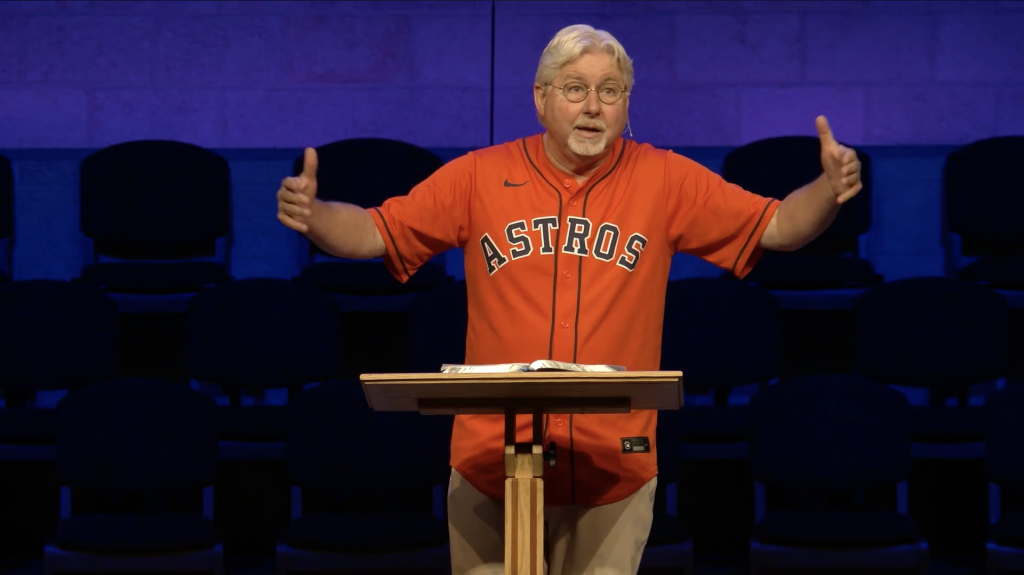
Senior Pastor Dr. Bruce Webb continues the series on the life of David with a Kickoff Sunday message on the Ark of the Covenant, the holiness of God, and the extravagant worship of a king who danced.
Now king, David determined to bring the Ark to his capital, and the symbolism was strong: he wanted the visible presence of God with him and with the nation. Imagine the excitement after sixty years. Second Samuel 6:1–5 describes the scene: “David again brought together all the able young men of Israel, thirty thousand. He and all his men went to Baalah in Judah to bring up from there the ark of God, which is called by the Name, the name of the Lord Almighty, who is enthroned between the cherubim on the ark. They set the ark of God on a new cart and brought it from the house of Abinadab, which was on the hill. Uzzah and Ahio, sons of Abinadab, were guiding the new cart with the ark of God on it, and Ahio was walking in front of it. David and all Israel were celebrating with all their might before the Lord, with castanets, harps, lyres, timbrels, sistrums and cymbals.” Notice, in passing, that the scribes considered God so holy they would not even write his covenant name.
Everything seems wonderful until verses 6 and 7: “When they came to the threshing floor of Nakon, Uzzah reached out and took hold of the ark of God, because the oxen stumbled. The Lord’s anger burned against Uzzah because of his irreverent act; therefore God struck him down, and he died there beside the ark of God.” The death was shocking. It put a damper on the entire celebration, and David was upset and angry. Uzzah, after all, seemed to be simply trying to help.
Radioactive Holiness
Perhaps we are uncomfortable with the way this story represents God. Perhaps we would prefer an explanation in which it did not really happen this way, because we would rather hear about God’s love than his holiness. However, the nature of God is not determined by our preferences. If we take nothing else from the text, we need to understand that we do not do life our way and expect good results; we do it his way. Dr. Webb shared a comparison he has found helpful: God’s presence is like radioactivity. Handled appropriately, it blesses. Handled wrongly, it blasts.
Here is the detail that resolves the difficulty: David had ignored God’s explicit instructions. According to 1 Chronicles 15, the Ark was to be moved only by consecrated Levites, carried on poles resting on their shoulders, never on a cart. David later confessed that when they first decided to move the Ark, he never asked the Lord how to do it. Furthermore, Numbers 4 had commanded that the Ark never be touched by human hands, which is precisely why it had golden rings for carrying poles. Uzzah would not have died had he and David done it God’s way. The Ark never needed rescuing; God can take care of his own work, and it is always a mistake to think we are protecting God’s work by doing things in a way God forbids.
Three Months at Obed-Edom’s House
Flustered and frightened, David parked the Ark at the home of Obed-Edom, where it remained for three months. How was he supposed to bring the Ark anywhere if this is what happened in the presence of God? However, the text immediately shows that God’s presence does not need to be feared. It needs to be reverenced. The problem was never his presence; the problem was how they were disregarding it. Second Samuel 6:11 says: “The ark of the Lord remained in the house of Obed-Edom the Gittite for three months, and the Lord blessed him and his entire household.”
The same promise stands for your household this fall. If you give God’s presence primacy and priority in your life, he will accomplish things you could never begin to achieve on your own. When David saw the blessing on Obed-Edom’s house, he understood, and he resolved to bring the Ark to his capital again, this time doing it God’s way.
Human nature being what it is, somebody probably went and fetched another new cart, because a cart is faster and more convenient. David refused. The poles went through the golden rings, the priests purified their hearts, and the Ark rose onto their shoulders. Second Samuel 6:13 records the pace: “When those who were carrying the ark of the Lord had taken six steps, he sacrificed a bull and a fattened calf.” Somebody surely muttered that they would never get there going that slowly. Dr. Webb imagines David’s reply: it may take a little longer to do life God’s way, but we know from experience we will never get there doing it ours.
The King Who Danced
As the Ark entered the City of David on God’s terms, notice David’s response in verses 14 and 15: “David, wearing a linen ephod, was dancing before the Lord with all his might, while he and all Israel were bringing up the ark of the Lord with shouts and the sound of trumpets.” This time David wore no royal garb. The humble linen ephod was his way of acknowledging that the Lord was King, not him. He was not thinking about what God had to offer him, but about what he had to offer God.
Now that David was fully aware God was on the throne and in control, the script of his life flipped: he became the one out of control, so unaware of himself in worship that he danced before the Almighty. Dr. Webb admits he loves the scene even though it makes him slightly uncomfortable, since he does not dance publicly. Not because he considers dancing a sin for a Christian, he clarifies, but because it looks like a sin when he does it. What matters is the posture underneath: David became so focused on the majesty and wonder of God that for a moment he stopped caring how he was perceived.
How long has it been, if ever, since God was so in control of your life that you cut loose and let go of control? How long since your life was an act of extravagant worship?
Mary’s Perfume and the Critics
The scene finds its New Testament echo in John 12, just days before the crucifixion, when Mary took an expensive jar of perfume and, overcome with gratitude, poured all of it on Jesus’ feet and wiped them with her hair. It was scandalous. She was not worried about how it looked, and she did not care what people said. The fragrance filled the whole room, and most importantly, it honored and pleased Jesus.
Not everyone approved, then or now. Judas Iscariot, treasurer for the disciples, objected that the perfume was worth a year’s wages and could have been given to the poor. Of course, Judas did not care about the poor at all; the truth is he was taking from what others gave. Similarly, when David danced, his wife Michal despised him, saying with sarcasm in 2 Samuel 6:20: “How the king of Israel has distinguished himself today, going around half-naked in full view of the slave girls of his servants as any vulgar fellow would!” David had not danced naked; he had simply traded his royal robe for a humble ephod. David pleased God with his dancing, just as Mary did with her perfume. It was Michal and Judas whom God rejected. If you ever worship like David or Mary, you will find out quickly that not everyone approves. Worship anyway.
What Would Your Extravagant Act of Worship Be This Fall?
This Kickoff Sunday, we do not have a box representing God. We have something far better: the living God revealed in Jesus Christ, present with his people. So the question Dr. Webb left with the congregation is worth sitting with. What would your extravagant act of worship be this fall, the one that would honor and please him?
Make It Known
For some, it would be proudly making it known at school or at work that you are a follower of Jesus, publicly declaring what has been silently true in your heart. For others, it means obeying God in baptism, even as an adult. The natural concern is what people will think; however, consider what God would think, and ask which matters more.
Forgive and Return
For others, extravagant worship might mean forgiving someone, or finally moving past a hurt that has kept you from serving Jesus and his church. Things happen sometimes that are not right and that wound us, even in the church. People occasionally tell Dr. Webb about a bad church experience, and his response is honest: he has had plenty of his own, probably more than most. Nevertheless, an extravagant act of worship might be refusing to let a bad experience that has nothing to do with Jesus keep you from serving him faithfully in his church somewhere.
Trust God With Your Finances
For still others, the extravagant act might be tithing. One of Dr. Webb’s best friends in Jacksonville was a rough-talking man named Stacey Davis, twice his age, who loved to tell about his first married paycheck. He was in the Army, and he and his wife Edith were barely scraping by. Edith came to him with tears in her eyes and said, “I want to tithe on my half.” Stacey stared at her, heard it a second time, then pitched the check across to her and said, “Well, you might as well tithe on all of it, because we can’t make it if we do on your half anyway.” Years later Stacey would say: “I will never in my life know how it worked, but God was faithful.”
Dr. Webb’s charge on this point was characteristically blunt: do not give a dime because of what a pastor says; the church budget is doing fine without it. At the same time, do not insult the presence of God by claiming Jesus as Lord while refusing to support his work anywhere. You will never know the wonderful things God can do with your life until you stop complaining about pastors talking about money and start being faithful with yours the way God’s Word clearly describes.
Surrender Control
Finally, for some the most extravagant act of worship would be to stop trying to control your religion altogether: to stop searching for a church that will be exactly what you want it to be, and instead allow God and his Word to take control of your life and determine its direction. That is the difference between Israel treating the Ark like a lucky charm and David carrying it on consecrated shoulders. One uses God. The other worships him.
Cut Loose and Dance
This fall can be the greatest season of your life if you give the holy presence of God, revealed perfectly in Jesus, the place of priority where he belongs. Jesus said: “Whoever wants to save their life will lose it, but whoever loses their life for me and for the gospel will save it.”
So, like David, let’s cut loose and dance.
If you are searching for a church near me in The Woodlands, TX where worship is genuine and Scripture is taught with honesty and depth, we would love for you to join us at The Woodlands First Baptist Church as the series on the life of David continues.
Learn More about The Woodlands First
► Watch the full sermon: https://www.youtube.com/watch?v=pz2yKvx4Y_4
► Plan your visit this Sunday: https://thewoodlandsfirst.org/new/
► Learn about our church: https://thewoodlandsfirst.org/beliefs/
► First Kids (Children’s Ministry): https://thewoodlandsfirst.org/ministries/first-kids/
Visit The Woodlands First Baptist Church
We offer worship services in traditional, modern, and Spanish-language styles across two campuses in The Woodlands, TX, along with Bible study classes and small groups for all ages.
South Campus: 11801 Grogan’s Mill Rd, The Woodlands, TX 77380
North Campus: 5148 FM 1488, The Woodlands, TX 77354
Phone: (281) 367-4317
Website: thewoodlandsfirst.org
Looking for churches near me in The Woodlands, TX? The Woodlands First Baptist Church has served this community since 1979. Come discover a community that takes Scripture seriously and welcomes everyone who is searching.

